

Importing Lithium Batteries into the US: Supplier Documents, Transport Tests and Customs Checks
9 min read
To import lithium batteries into the US, match supplier records to the exact battery, check UN 38.3 transport evidence, and confirm shipping and customs requirements with qualified advisers before ordering.


BIGEXPORT Editorial Team
Electrical & Electronics
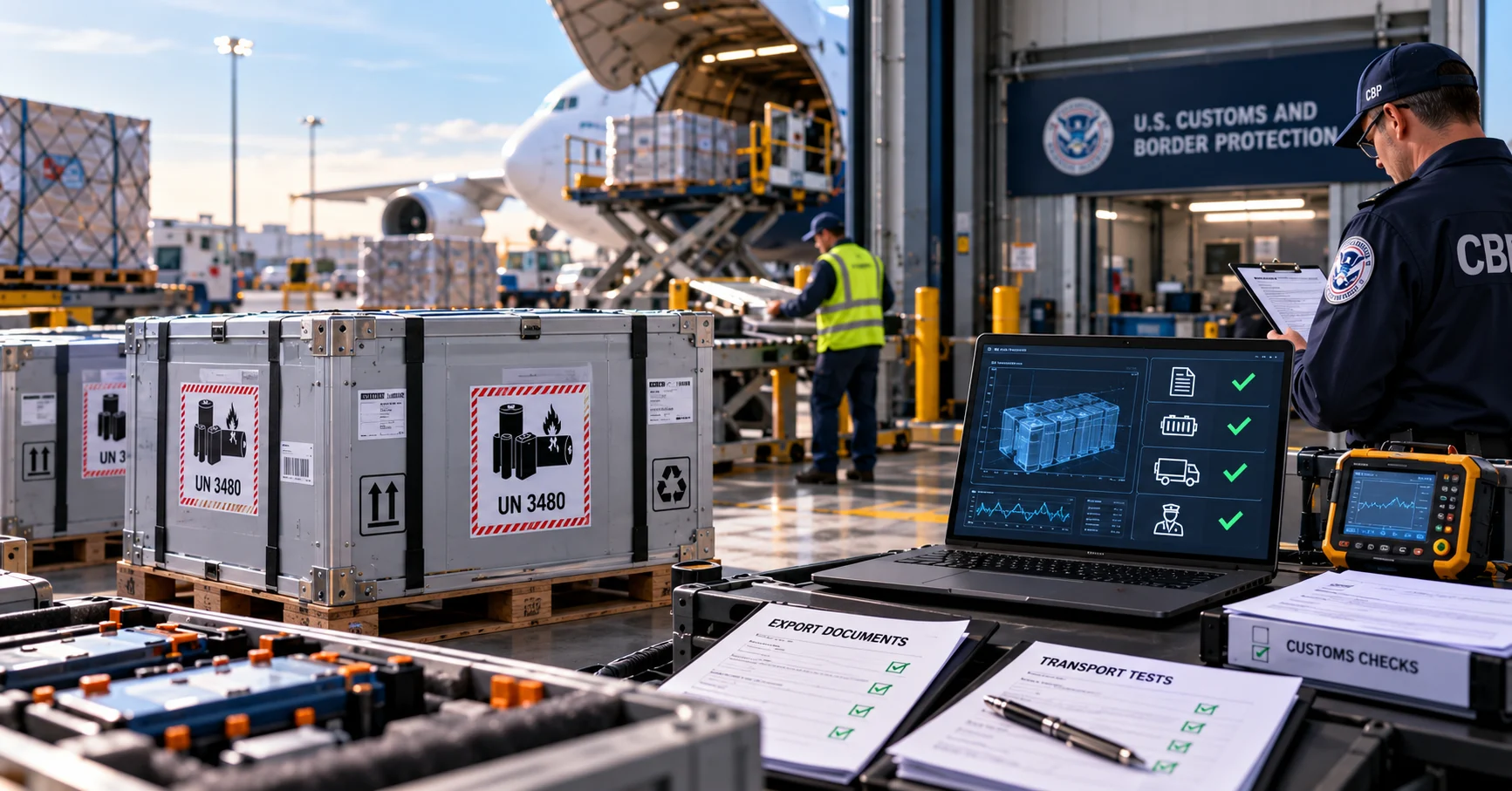
To import lithium batteries into the US, match supplier records to the exact battery, check UN 38.3 transport evidence, and confirm shipping and customs requirements with qualified advisers before ordering.
What should buyers establish before requesting quotations?
A usable lithium battery quotation starts with the battery’s chemistry, configuration, energy content and intended application. These details drive transport planning, supplier document review and customs classification, so “rechargeable battery” is not an adequate purchasing specification.
Identify the battery and its shipping configuration
Separate lithium-ion batteries, including lithium iron phosphate variants, from lithium metal batteries. Then identify whether the shipment contains batteries alone, batteries packed with equipment or batteries installed in equipment.
Request these specifications before comparing suppliers:
Manufacturer, manufacturing location and exact cell and battery model numbers.
Chemistry, nominal voltage, rated capacity and watt-hour rating.
Lithium content for lithium metal products, where relevant.
Cell arrangement, battery mass, dimensions and terminal design.
Intended use, equipment compatibility and battery management features.
Shipment configuration, quantity and proposed transport mode.
Whether the goods are new, used, prototypes, damaged, defective or intended for recycling.
Watt-hours can be calculated from nominal voltage multiplied by ampere-hours, but buyers should reconcile that calculation with the manufacturer’s rating and documentation. A product listing’s headline capacity is not a substitute for technical specifications.
Keep transport identifiers separate from customs codes
UN dangerous-goods identifiers describe transport hazards and configurations; HS and US HTS classifications describe goods for customs purposes. One does not determine the other.
The following matrix is a starting point for classification discussions, not a shipping authorization. Confirm the applicable description, exceptions, packing instructions and carrier acceptance against the rules in force for the shipment.
Battery and configuration | Common transport identifier to assess | Evidence to request | Main purchasing concern |
|---|---|---|---|
Lithium-ion batteries shipped alone | UN 3480 | Model-linked UN 38.3 summary, ratings and packaging proposal | Standalone battery restrictions and route acceptance |
Lithium-ion batteries packed with or contained in equipment | UN 3481 | Battery evidence plus equipment and packing details | Correct distinction between packed-with and installed configurations |
Lithium metal batteries shipped alone | UN 3090 | Model-linked UN 38.3 summary and lithium-content information | Transport eligibility and applicable quantity limits |
Lithium metal batteries packed with or contained in equipment | UN 3091 | Battery evidence, lithium content and equipment details | Configuration-specific packing and marking |
Damaged, defective, prototype or recycling shipments | Requires specialist assessment | Condition, purpose and technical supporting records | Whether the proposed mode and route are permissible |
Decision point: Do not accept “ships with equipment” as an explanation for simpler transport treatment. Ask the supplier to show exactly how the batteries and equipment will be packed.
Which supplier documents should procurement collect?
Procurement should obtain a model-specific technical and transport document pack before releasing a purchase order. The records must describe the goods actually being purchased, with discrepancies resolved before shipment rather than at the port or airport.
Build a traceable document pack
Ask for the following documents, distinguishing what is needed for supplier evaluation from what must accompany or support the shipment.
Document or record | What the buyer should check | What it does not establish |
|---|---|---|
Product specification and drawing | Chemistry, model, voltage, capacity, dimensions and application | Transport eligibility or product safety compliance |
UN 38.3 test summary | Manufacturer, laboratory, report reference, battery description and test results | Blanket approval for every product from that supplier |
Supporting transport test report, where needed | Link to the purchased battery design and explanation of any variations | Acceptance by every carrier or route |
Safety data sheet, if supplied or requested | Product identification and consistency with other records | Replacement for UN 38.3 evidence or shipping documents |
Commercial invoice and packing list | Descriptions, quantities, values, weights and packing configuration | Correct customs classification by themselves |
Origin and manufacturer records | Evidence supporting the stated manufacturing origin | Origin based merely on the dispatch country |
Application-specific safety evidence | Standard, scope, model coverage and issuer | Compliance outside the evidence’s stated scope |
A laboratory logo or a document titled “battery certificate” is not enough. Procurement should be able to connect the legal supplier, actual manufacturer, purchased model and relevant supporting records.
Separate product safety from transport testing
UN 38.3 concerns transport testing, not comprehensive approval for every end use. A battery intended for stationary storage, consumer electronics or industrial equipment may need a different product safety assessment.
Ask a qualified product compliance adviser which standards, testing, labeling and market-access checks apply to the intended US application. Where relevant, verify matters with the competent authority, such as the Consumer Product Safety Commission, rather than treating a supplier’s general compliance statement as conclusive.
Check the supplier behind the paperwork
Confirm the contracting entity, production location, bank beneficiary and whether the seller manufactures the battery or sources it from another company. Investigate inconsistent names, unexplained model substitutions and documents that cannot be linked to the quoted goods.
An inspection can help confirm quantities, markings, workmanship and agreement with the purchase specification. It does not replace laboratory testing, transport classification or customs advice.
How should buyers review UN 38.3 transport evidence?
A UN 38.3 test summary should connect the purchased cell or battery type to identifiable testing and results. Buyers should review that connection rather than accepting a generic “UN 38.3 certified” statement.
Check the summary against the order
Use the applicable UN Manual of Tests and Criteria, subsection 38.3, to guide review with a competent dangerous-goods specialist. A practical review should examine:
Manufacturer and test laboratory identification and contact details.
Unique test report reference and report date.
Battery or cell description, including relevant model identifiers.
Physical characteristics and energy or lithium-content information.
Applicable tests and their recorded results.
The referenced edition or amendment of the test criteria.
Identification and signature of the responsible signatory.
The test sequence addresses hazards such as altitude, thermal exposure, vibration, shock and electrical or mechanical abuse, with applicability depending on the item tested. Buyers should not infer that all tests apply identically to every cell and assembled battery.
Investigate design changes and model families
A shared enclosure or brand name does not prove that two battery models have equivalent transport evidence. Changes to cells, protective devices, electrical configuration or other design features can require a technical review of whether existing evidence remains applicable.
Ask the manufacturer to explain how the report covers the exact ordered model. Where reliance is placed on cell testing or an assembled-battery provision, obtain the technical basis and have a specialist assess it.
Warning: An SDS, a cell report and an unrelated battery test summary are not interchangeable. Stop document approval when the ordered battery cannot be traced to the evidence provided.
How should importers plan transport and US customs clearance?
Transport acceptance and customs clearance are separate workstreams that must be coordinated before dispatch. A battery can have credible test evidence yet still face delays because its packaging, carrier booking, classification, value or origin records are incomplete.
Confirm the route before accepting the delivery promise
Have a qualified dangerous-goods forwarder assess the exact battery, shipment configuration and route. Air and ocean transport have different frameworks, and carrier policies may be more restrictive than baseline provisions.
For US hazardous-materials transport questions, verify applicable requirements with PHMSA and, for aviation matters, the FAA. For air or ocean movements, consult the applicable ICAO framework, IATA guidance or IMDG Code through a competent specialist, alongside carrier conditions.
Resolve these points before booking:
Applicable dangerous-goods description and packing instructions.
Packaging, short-circuit protection, marks and labels.
State-of-charge conditions, where applicable.
Required transport documentation and trained-person responsibilities.
Transit-country restrictions and connecting-carrier acceptance.
Procedures for rejected freight, damage or returns.
Do not assume that an ordinary parcel service will accept the shipment because a supplier has used it previously.
Establish customs treatment independently
Ask a licensed US customs broker to assess the appropriate HTS classification using the battery’s technical characteristics and shipment presentation. Loose batteries, complete equipment and batteries shipped alongside equipment can raise different classification questions.
Verify the current HTS schedule with the US International Trade Commission and customs treatment with US Customs and Border Protection. Where classification uncertainty is commercially significant, discuss whether a CBP binding ruling is appropriate.
Provide the broker with accurate transaction values, origin evidence and information about tooling, assists, royalties or related-party transactions where relevant. Have the broker assess applicable duties, additional tariffs, trade remedies and any other agency requirements using official sources for the actual origin and entry circumstances.
Define delivery and cost responsibilities
Use an Incoterms 2020 rule with a precise named place to allocate delivery responsibilities and risk. Separately identify who will act as importer of record, arrange dangerous-goods services and provide customs information.
Compare quotations on landed cost, not unit price alone. Include freight, dangerous-goods handling, packaging, insurance, duties, brokerage and potential storage or rework costs; verify amounts for the specific shipment rather than applying a generic battery surcharge.
What should a purchase-ready lithium battery RFQ contain?
A purchase-ready RFQ specifies the exact battery and requests evidence, logistics assumptions and commercial terms in a comparable format. It should make document approval and shipment release separate decisions, with named people responsible for each.
Use a staged procurement checklist
1. Define the product: State chemistry, application, ratings, model requirements, dimensions and quantity.
2. Define the shipment: Specify batteries alone, packed with equipment or installed, plus destination and preferred mode.
3. Request evidence: Ask for model-linked UN 38.3 summaries, specifications, manufacturing details and relevant product safety records.
4. Screen the supplier: Check entity details, manufacturing claims, document consistency and payment beneficiary.
5. Validate the sample: Confirm agreement with specifications and arrange application-specific evaluation where needed.
6. Clear the route: Obtain written forwarder confirmation of the proposed configuration and carrier acceptance.
7. Review customs treatment: Have the broker assess classification, origin, valuation and applicable duties.
8. Compare quotations: Require MOQ, lead time, packing details, payment terms and the named Incoterms 2020 location.
9. Set change controls: Require notice of cell, design, factory or model changes before production or shipment.
10. Release shipment: Reconcile approved goods with final invoice, packing list, transport records and inspection findings.
Make discrepancies commercially actionable
The purchase agreement should identify the approved product and the documents the supplier must provide. It should also address unauthorized substitutions, document discrepancies, inspection arrangements and responsibility for avoidable rework, subject to legal review.
A payment milestone tied to document review can support procurement control, but it is not a guarantee of compliance or performance. Maintain your own approval records and do not allow a freight booking deadline to substitute for technical review.
Frequently asked questions
An SDS alone is not sufficient evidence for transport or customs planning. Request model linked UN 38.3 evidence and have a dangerous goods specialist confirm the applicable shipping documentation. Separately, ask your broker to review the customs records and any relevant agency requirements.
UN 38.3 addresses transport testing rather than comprehensive product approval. Identify the battery’s intended application and have a qualified adviser assess relevant product safety, labeling and market access considerations. Verify applicable requirements with the competent authority and ensure any supporting evidence covers the purchased model.
A cell report does not automatically establish the transport status of an assembled battery pack. Ask for the battery level test summary or the documented technical basis for relying on another applicable provision. Have a competent specialist evaluate that basis against the actual design before approving shipment.
There is no reliable single answer covering every lithium battery shipment and configuration. Give your customs broker the chemistry, function, technical specifications and details of whether the goods are loose batteries or part of equipment. Verify classification against the current US HTS schedule and consider a CBP ruling where uncertainty is material.
BIGEXPORT is an AI supported, confidential B2B RFQ communication and matching platform, not a supplier verification or transaction guarantee service. Buyers remain responsible for supplier due diligence, document review and commercial agreements. BIGEXPORT charges no transaction commission, does not become party to contracts and guarantees no payment, delivery, quality or commercial outcome.